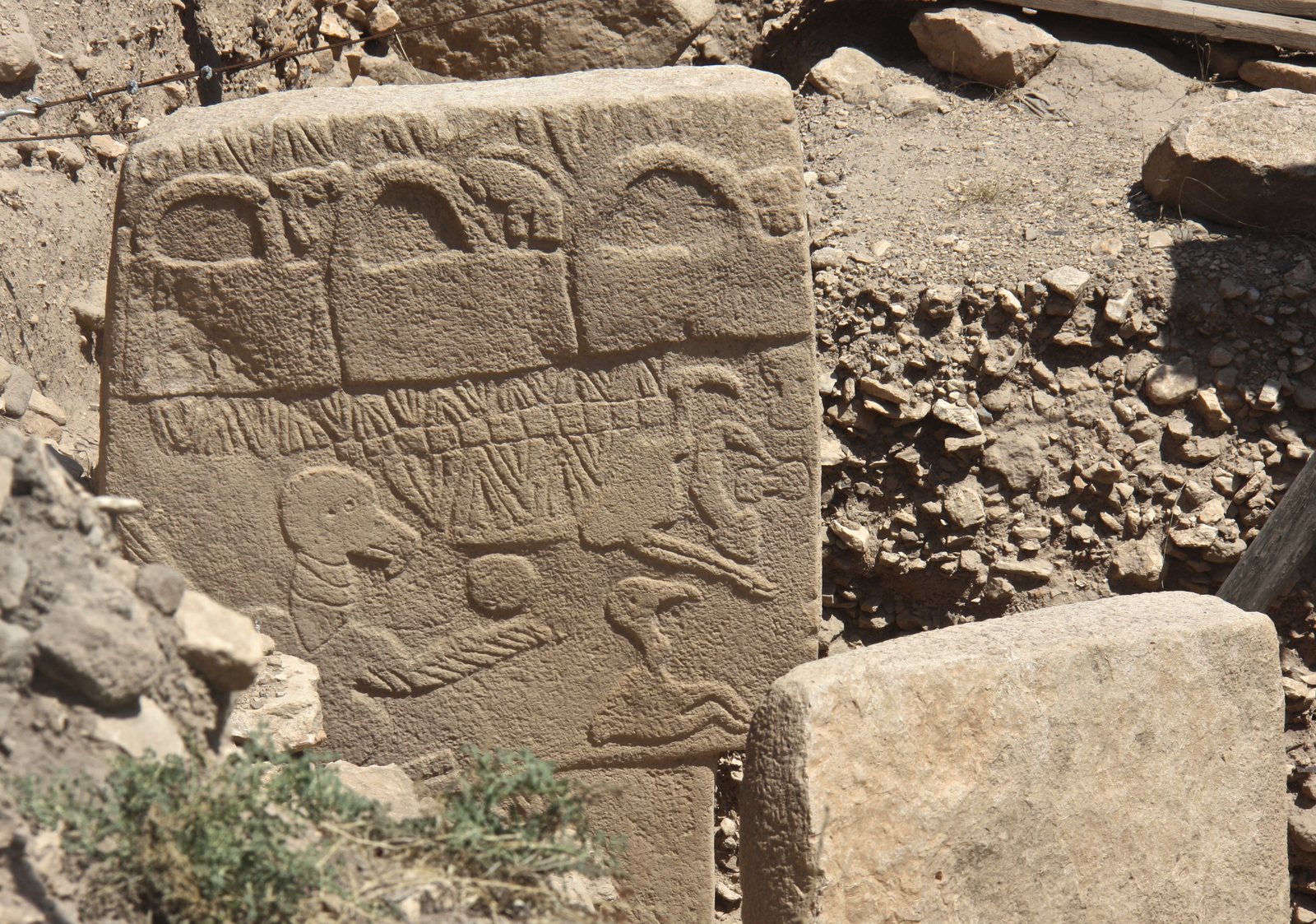
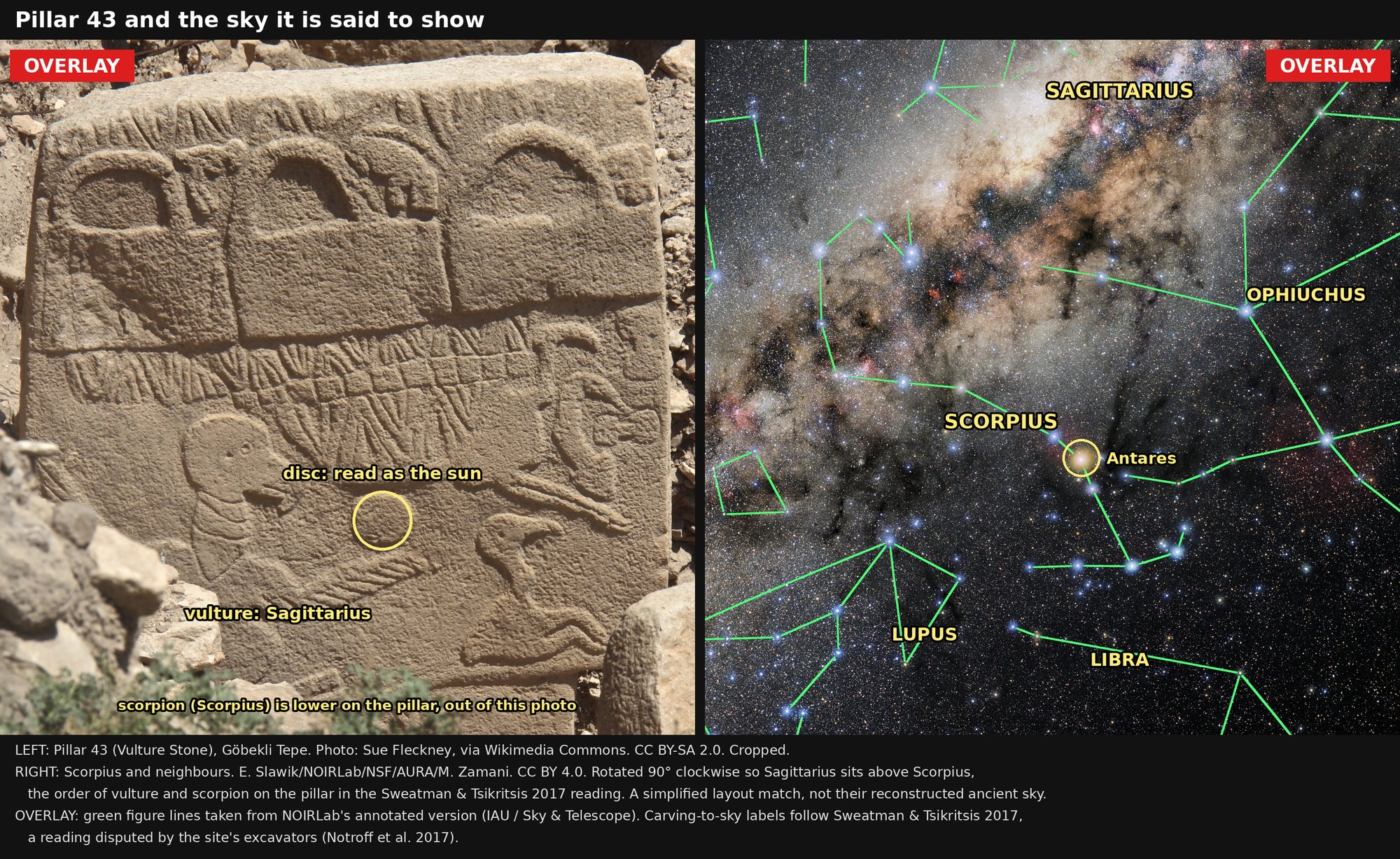
Pillar 43, the Vulture Stone, in Enclosure D at Göbekli Tepe: the vulture with outstretched wing and the disc above it. The scorpion is lower on the pillar, out of this photo. Photo: Sue Fleckney, via Wikimedia Commons, CC BY-SA 2.0 (share-alike).
Establishing a Radiocarbon Sequence for Göbekli Tepe (Neo-Lithics 1/13) →Neo-Lithics 1/13, 2013, DAI excavation team (PDF)The excavators' dating report. It gives sample KIA-44149 from the wall plaster of Enclosure D between Pillars 41 and 42, 9745–9314 cal BC, and charcoal from the enclosure at 9664–9311 cal BC, placing construction in the mid-10th millennium BC.
More than a vulture: A response to Sweatman and Tsikritsis (Notroff et al. 2017) →Mediterranean Archaeology and Archaeometry 17(2), 2017 (PDF)The excavators' rebuttal: pillars were moved and reused, the buildings may have been roofed, and the 10950 BC date is 700 to 1,000 years older than Enclosure D's oldest radiocarbon dates.
Three unusual shapes carved across the upper part of Göbekli Tepe’s famous Pillar 43 have been compared to handbags, baskets and buckets for years. A new interpretation proposed by Turkish lecturer ...
Louvre AO 6769: tablet, prayer for the examination of entrails →Musée du Louvre, collections databaseThe museum record for text B of the Prayer to the Gods of the Night, dated by the Louvre to 1800–1700 BC. It has the object's size (9.9 by 5.2 cm), acquisition in 1914 and the museum's photos.
Prayer to the Gods of the Night: text and translation (SEAL 7491) →SEAL, Hebrew University of JerusalemA full English translation of the Old Babylonian prayer, which calls on the Bow, the Yoke, Orion, the Dragon, the Wagon, the She-Goat, the Bison and the Horned Serpent. It lists the editions from Šilejko 1924 to Mayer 2018.
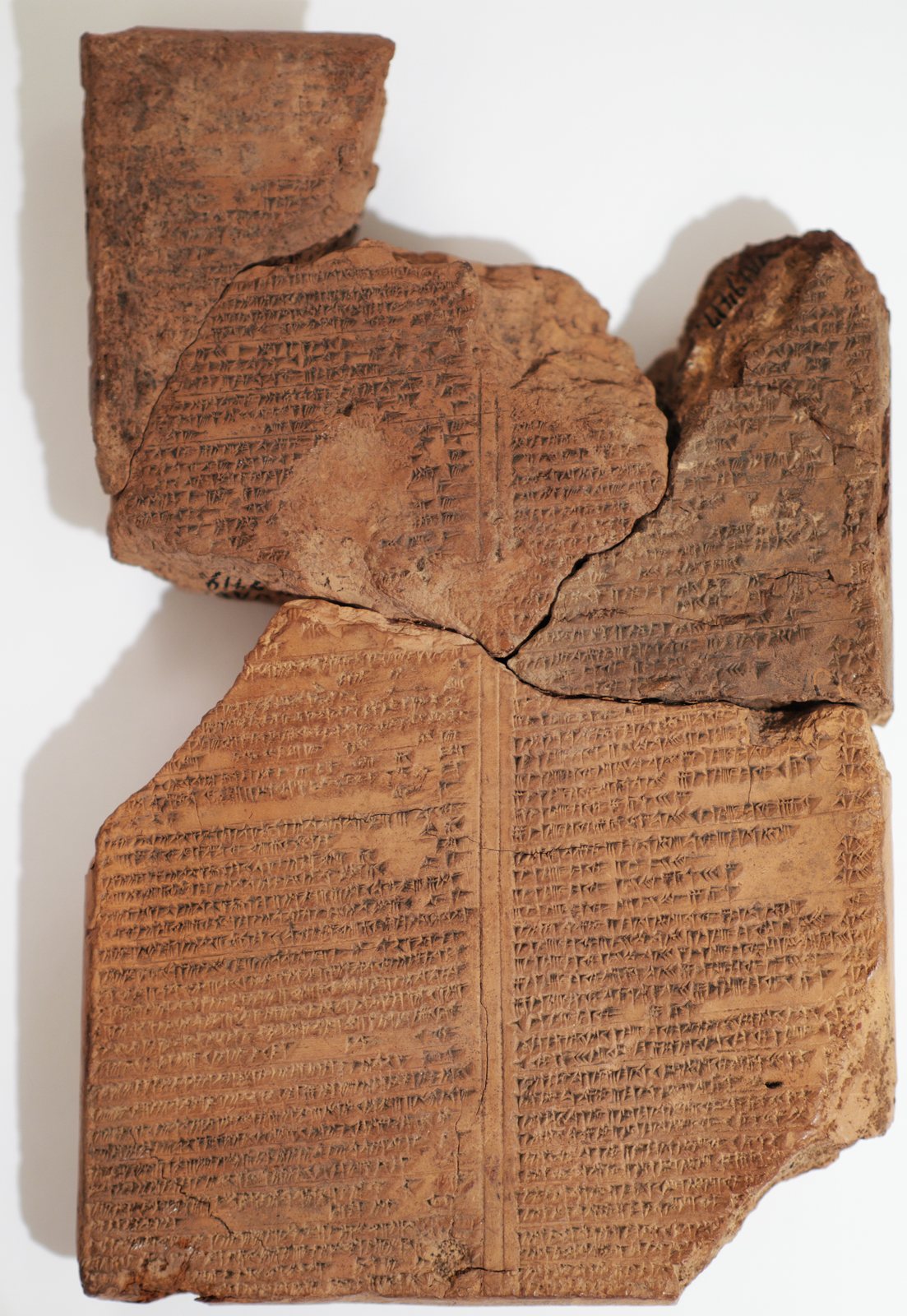
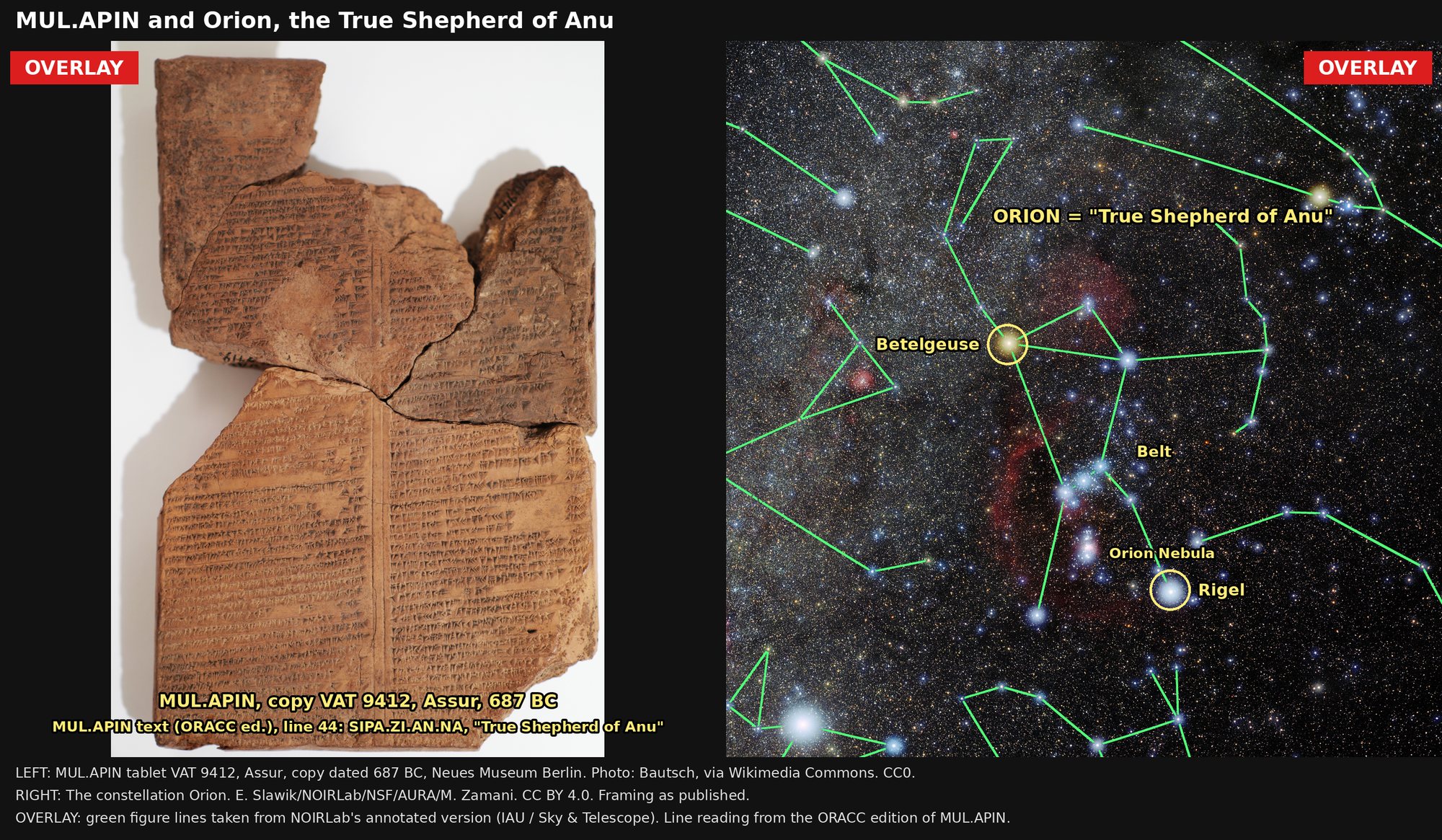
VAT 9412, a copy of the star catalogue MUL.APIN from Assur, Neues Museum Berlin. Its colophon dates the copy to 687 BC, the oldest dated copy known. Photo: Bautsch, via Wikimedia Commons, CC0.
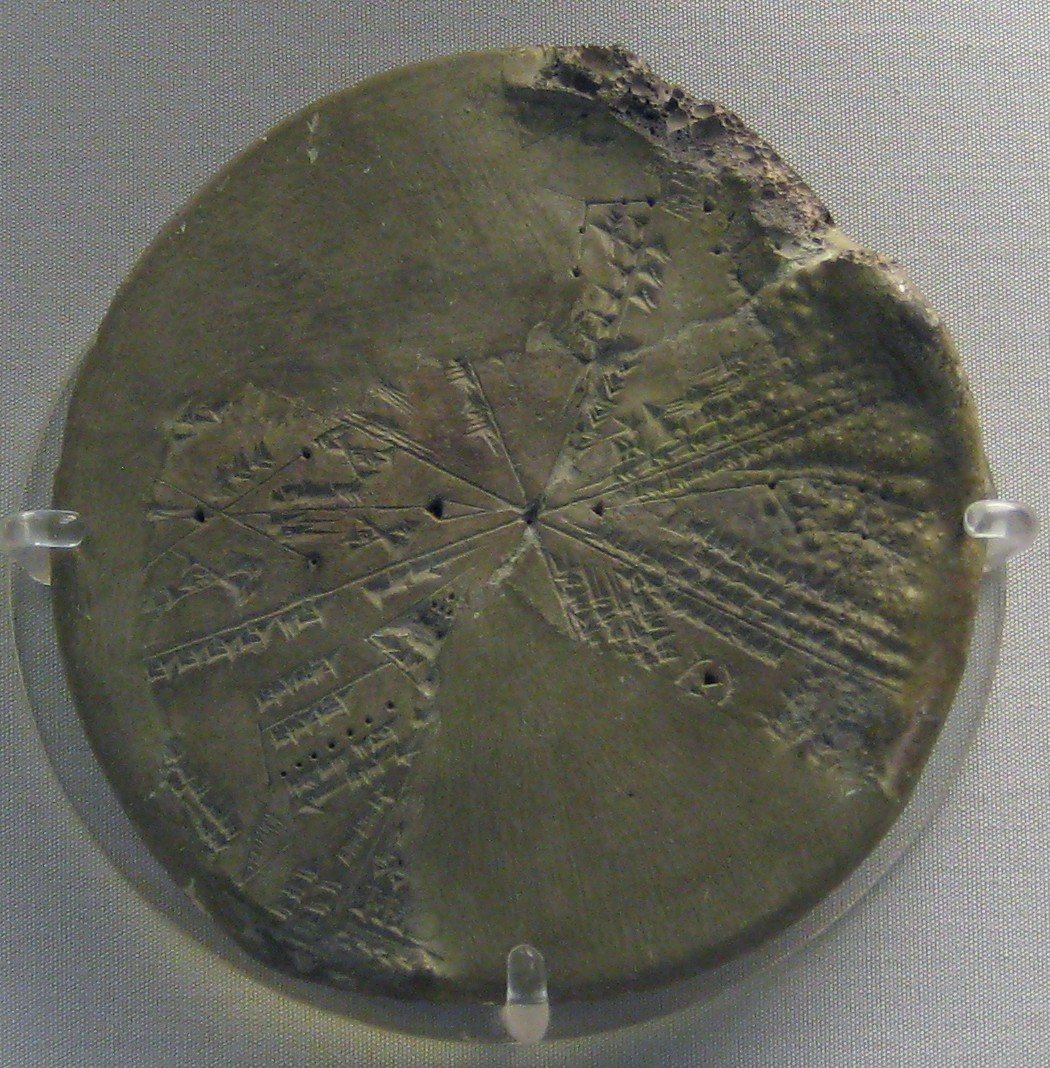
K.8538, a clay star chart from Ashurbanipal's library at Nineveh, British Museum. The museum's curator dates the sky it shows to the night of 3–4 January 650 BC. Photo: BabelStone, via Wikimedia Commons, CC0.
The collection of Viking Age coins found by a metal detectorist scouring his hometown Lahti City Museums A metal detectorist in southern Finland has unearthed the country’s largest hoard of Late Iron ...
Himera and Denmark’s GomSpace say OBRIA NANO, launched on SpaceX’s Transporter‑18 on 1 October, is operating as planned and has begun technical trials ...
The ESA-supported mission validates next-generation communications technologies in orbit, strengthens GomSpace's flight heritage, and supports future commercial and institutional opportunities.
STOCKHOLM, Oct. 27, 2026 /PRNewswire/ -- Ukraine's HIMERA and Denmark's GomSpace have launched OBRIA NANO – the first test satellite for a future independent Ukrainian communications network – into ...
The Denisovan story began in 2010, when genetic material from a finger bone found in Siberia’s Denisova Cave revealed an unexpected branch of the human family. Since then, researchers have linked ...
Protein and cranial analyses link Xujiayao to the Denisovan lineage and support the same broad assignment for several other East Asian archaic Homo fossils.
It’s the start of a supernatural season, and this month is packed with astronomical events to check out. This month, we'll have plenty of chances to view the inner planets in the night sky and two ...
Despite the fact that this meteor shower seems to come from the constellation Orion, meteors can fly in various directions. According to NASA, the best place to see long meteor trails would be about ...
The best time to watch a meteor shower is typically after midnight, or in the early predawn hours, when there’s usually less interference from moonlight.
Astronomers using the European Southern Observatory’s Very Large Telescope (ESO’s VLT) have found a rare disc of debris around a dead star that provides a ...
An international team led by astronomers from the University of Trieste and the University of Warwick has discovered a double ring of planetary debris ...
The 4 · main stories
Ancient
A Metal Detectorist Hit a Signal Under a Scottish Cairn
A Bronze Age hoard found in 2022 inside a cairn near Blyth Bridge in the Scottish Borders, dated about 1150-800 BC, holds two bronze axe heads, Scotland's first complete copper ingot, and clay mould pieces that seem to match the Peebles Hoard 7 miles away (National Museums Scotland). Source: The Daily Galaxy, Oct 26, 2026.
Mars rover tracks from a historic drive | Space photo of the day for Oct. 27, 2026
NASA's Perseverance rover looked back at its own wheel tracks after passing 28.10 miles (45.22 km) driven on Oct. 11, the farthest any vehicle has gone on another world. Opportunity needed about 14 years for that distance; Perseverance did it in just over 5. Source: Space.com, Chelsea Gohd, Oct 27, 2026.
Origins of Peru's Alien Mummies Explained in New DNA Study
Older story, published Aug 15, 2025. DNA reviews of Peru's so-called alien mummies point to human remains, perhaps with rare inherited conditions such as extra fingers (a Gli3 gene change was flagged). Some researchers still dispute this, and earlier forensic work called several figures fakes. Source: Colombia One, Abdul Moeed.
Ukrainian startup, GomSpace test satellite for future communications network
The companies said the experimental spacecraft, launched Oct. 1, could lead to a Ukrainian-controlled satellite network The post Ukrainian startup, GomSpace test satellite for future communications network appeared first on SpaceNews.
Pillar 43 at Göbekli Tepe: the oldest object claimed as a star map
Pillar 43 at Göbekli Tepe in Turkey was carved about 11,500 years ago. In 2017 two researchers read its vulture and scorpion as Sagittarius and Scorpius and called it a date stamp for 10950 BC. The archaeologists who dig the site reject that reading. Status: unproven.
UNESCO World Heritage Centre · Oct 27
Original headline: Göbekli Tepe - UNESCO World Heritage CentreRead the source →
Pillar 43, the Vulture Stone, in Enclosure D at Göbekli Tepe: the vulture with outstretched wing and the disc above it. The scorpion is lower on the pillar, out of this photo. Photo: Sue Fleckney, via Wikimedia Commons, CC BY-SA 2.0 (share-alike).
Establishing a Radiocarbon Sequence for Göbekli Tepe (Neo-Lithics 1/13) →Neo-Lithics 1/13, 2013, DAI excavation team (PDF)The excavators' dating report. It gives sample KIA-44149 from the wall plaster of Enclosure D between Pillars 41 and 42, 9745–9314 cal BC, and charcoal from the enclosure at 9664–9311 cal BC, placing construction in the mid-10th millennium BC.
More than a vulture: A response to Sweatman and Tsikritsis (Notroff et al. 2017) →Mediterranean Archaeology and Archaeometry 17(2), 2017 (PDF)The excavators' rebuttal: pillars were moved and reused, the buildings may have been roofed, and the 10950 BC date is 700 to 1,000 years older than Enclosure D's oldest radiocarbon dates.
B · ORACC
The oldest clay tablets that name the stars
The oldest clay tablets that certainly name constellations are far younger. A Babylonian prayer to the "gods of the night," on a tablet the Louvre dates to 1800–1700 BC, calls on Orion and the Pleiades by name. The star catalogue MUL.APIN, in copies from 687 BC, calls Orion the True Shepherd of Anu. Status: accepted; MUL.APIN's first date is debated.
ORACC · Oct 27
Original headline: MUL.APIN tablet 1, ORACC online editionRead the source →
Louvre AO 6769: tablet, prayer for the examination of entrails →Musée du Louvre, collections databaseThe museum record for text B of the Prayer to the Gods of the Night, dated by the Louvre to 1800–1700 BC. It has the object's size (9.9 by 5.2 cm), acquisition in 1914 and the museum's photos.
Prayer to the Gods of the Night: text and translation (SEAL 7491) →SEAL, Hebrew University of JerusalemA full English translation of the Old Babylonian prayer, which calls on the Bow, the Yoke, Orion, the Dragon, the Wagon, the She-Goat, the Bison and the Horned Serpent. It lists the editions from Šilejko 1924 to Mayer 2018.
VAT 9412, a copy of the star catalogue MUL.APIN from Assur, Neues Museum Berlin. Its colophon dates the copy to 687 BC, the oldest dated copy known. Photo: Bautsch, via Wikimedia Commons, CC0.
K.8538, a clay star chart from Ashurbanipal's library at Nineveh, British Museum. The museum's curator dates the sky it shows to the night of 3–4 January 650 BC. Photo: BabelStone, via Wikimedia Commons, CC0.
Side A is the oldest object said to show the stars, Pillar 43 at Göbekli Tepe, carved about 11,500 years ago. Side B is the oldest clay tablets known to name them. Here both sit beside telescope photographs of the same stars as they are today.
Side by side
Pillar 43, the Vulture Stone, beside the Scorpius sky, turned 90 degrees clockwise so Sagittarius sits above Scorpius, the order of vulture and scorpion in the Sweatman and Tsikritsis reading. A simple layout match, not a reconstruction of the sky in 10950 BC; the scorpion is carved lower on the pillar, out of this photo. Left: Sue Fleckney, via Wikimedia Commons (CC BY-SA 2.0), cropped. Right: E. Slawik/NOIRLab/NSF/AURA/M. Zamani (CC BY 4.0), rotated, with figure lines from NOIRLab's annotated version (IAU and Sky & Telescope). CC BY-SA 2.0 Share-alike: this composite is shared under the same CC BY-SA 2.0 licence. SourceThe MUL.APIN tablet VAT 9412, copied in 687 BC, beside Orion, which the text calls the True Shepherd of Anu. Left: Bautsch, via Wikimedia Commons (CC0). Right: E. Slawik/NOIRLab/NSF/AURA/M. Zamani (CC BY 4.0), with figure lines from NOIRLab's annotated version (IAU and Sky & Telescope). CC BY 4.0Source
Take A: the sky behind Pillar 43
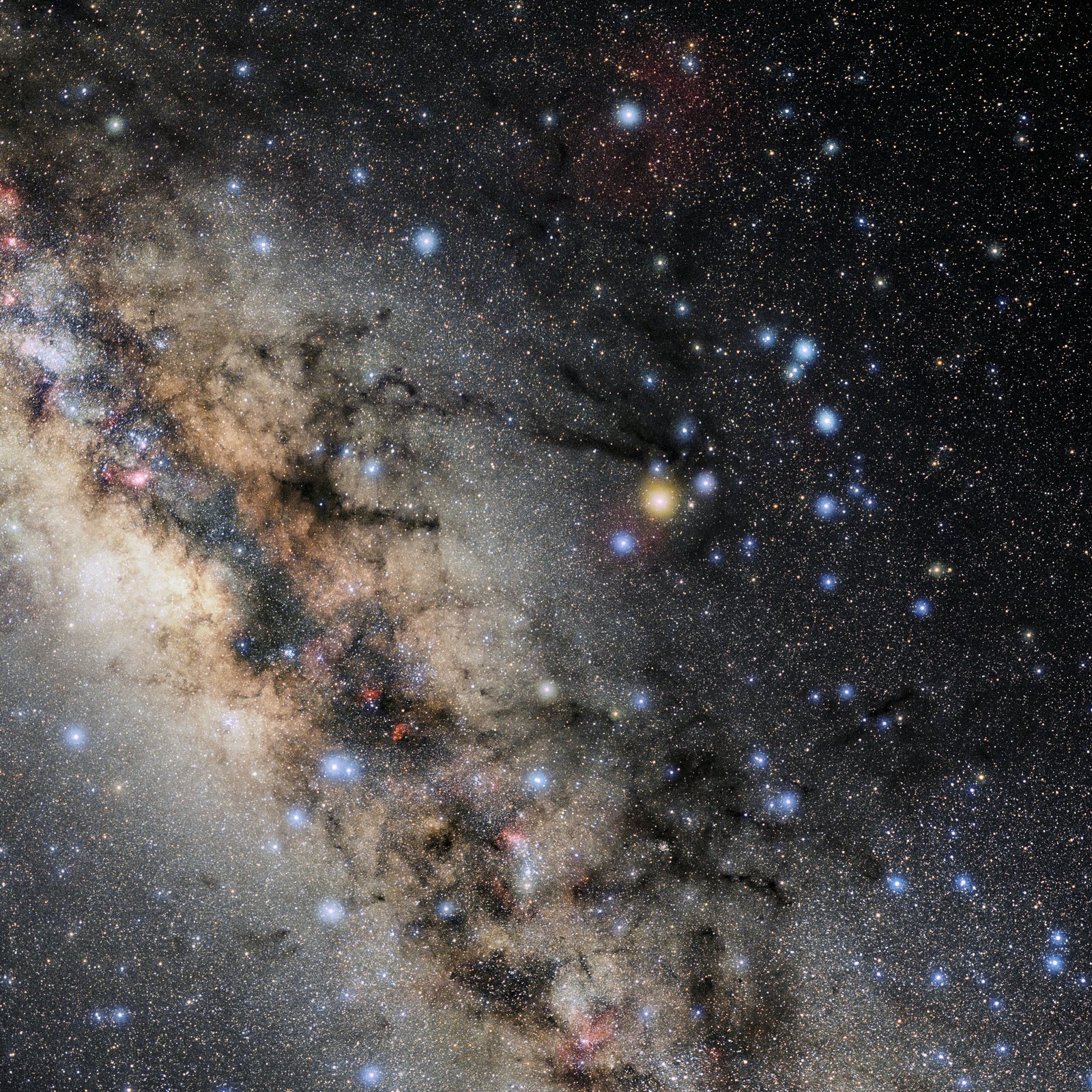
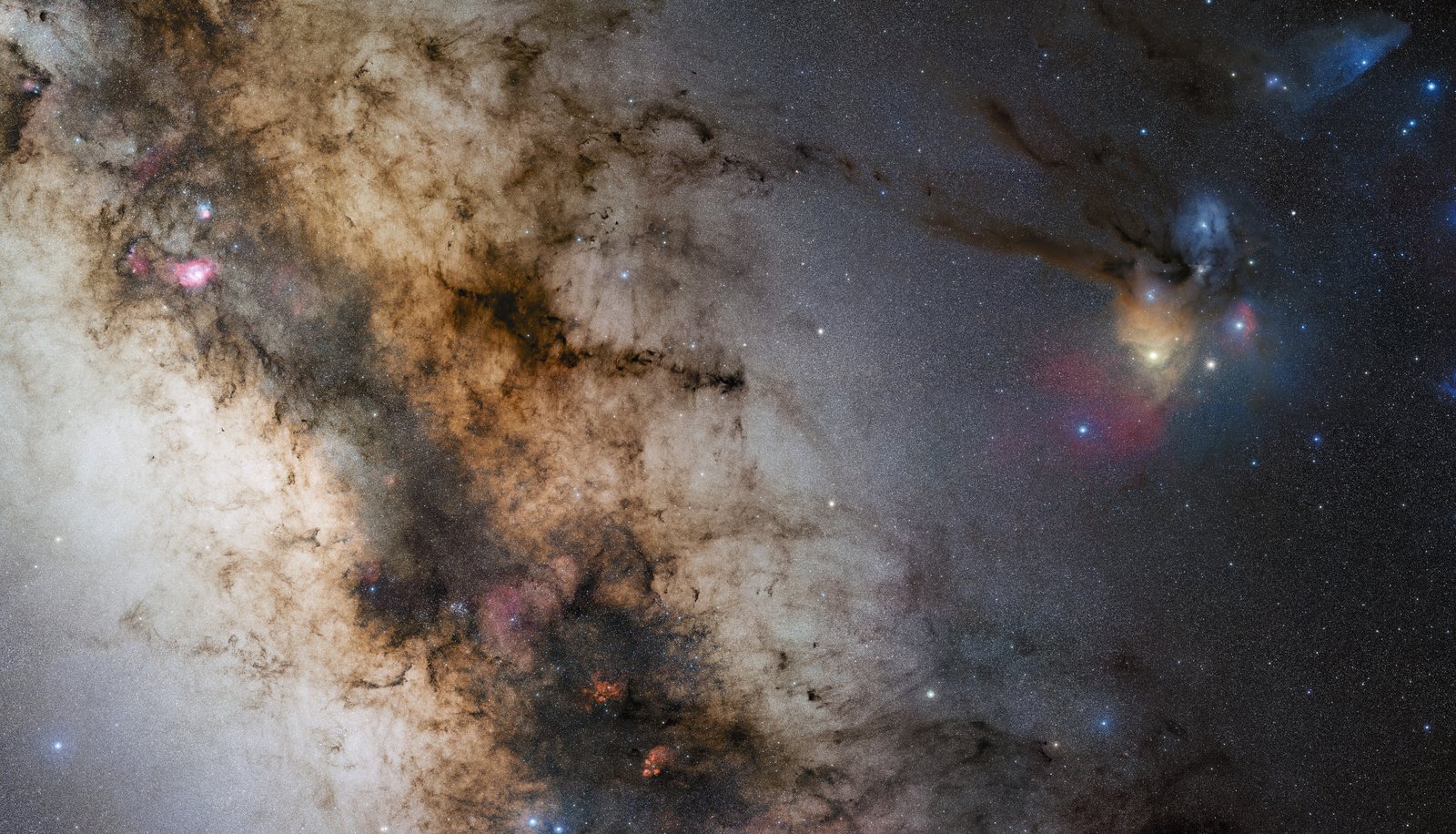
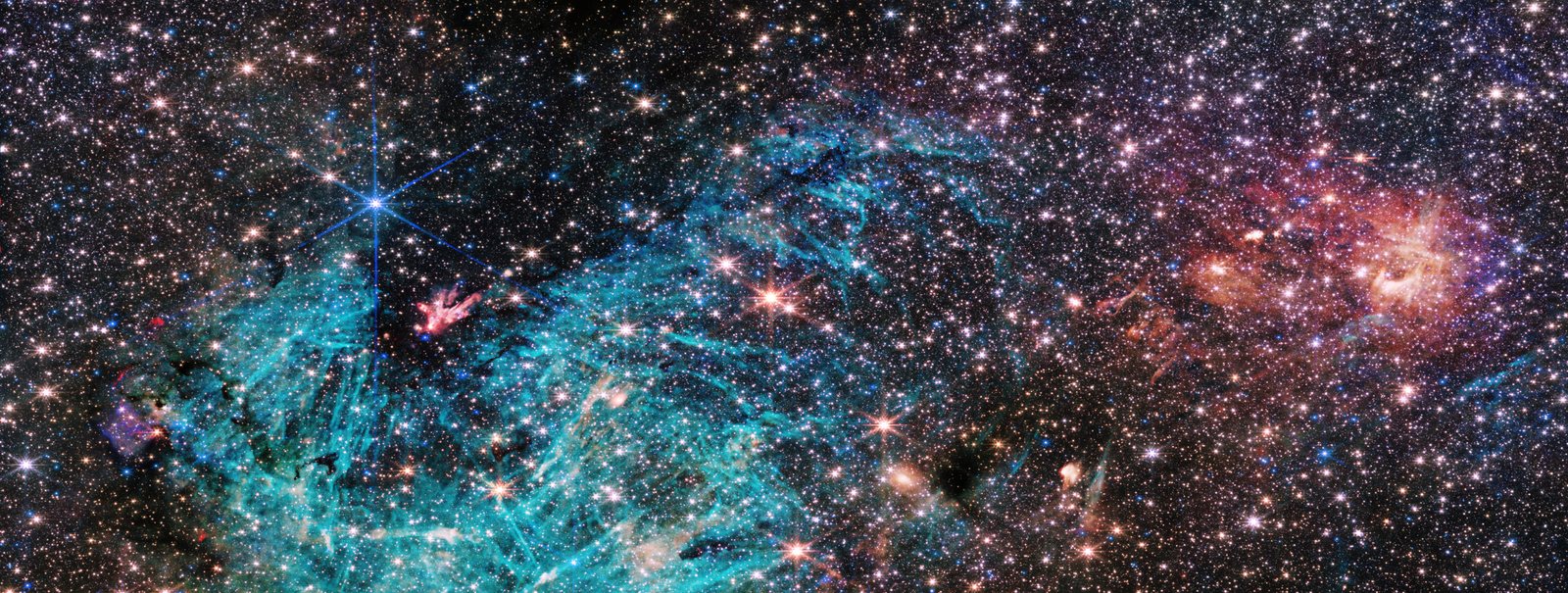
Sweatman and Tsikritsis match the scorpion and vulture on Pillar 43 to Scorpius and Sagittarius. The brightest star in Scorpius is Antares, a red supergiant; a 2017 study in Nature put it about 550 light-years away. Behind Sagittarius the distances grow: the Lagoon Nebula is about 4,000 light-years off, and Sagittarius C lies near the centre of the Milky Way, about 25,000 light-years away. A constellation is a pattern seen from Earth. Earth's axis also wobbles like a spinning top, on a cycle NASA gives as about 25,771.5 years. From 9600 BC to 2026 is about 45 percent of one cycle (our calculation from NASA's figure), so the sky over Göbekli Tepe when Enclosure D was built sat at a very different angle to the seasons. The 10950 BC date in the star-map reading rests on this effect.
Scorpius, whole constellation. The bright red star in the body is Antares. E. Slawik/NOIRLab/NSF/AURA/M. Zamani. CC BY 4.0SourceSagittarius to Scorpius, wide, from ESO's Paranal Observatory in Chile. ESO/S. Guisard (www.eso.org/~sguisard). CC BY 4.0SourceClose-up: the Lagoon Nebula in Sagittarius, about 4,000 light-years away. NASA, ESA, STScI. CC BY 4.0SourceClose-up, infrared: Sagittarius C, near the centre of the Milky Way. NASA, ESA, CSA, STScI, S. Crowe (UVA). CC BY 4.0Source
Take B: the sky behind the tablets
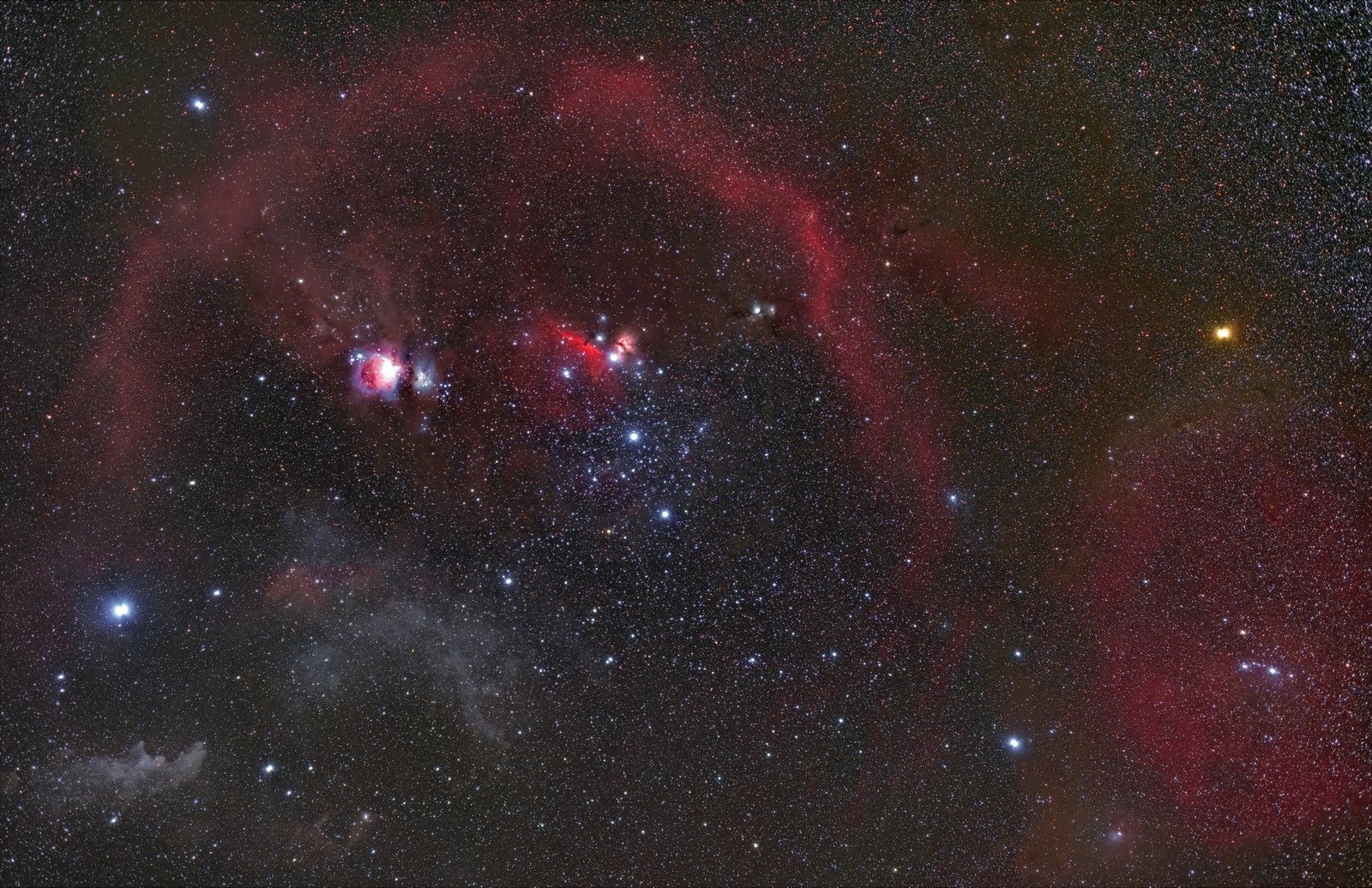
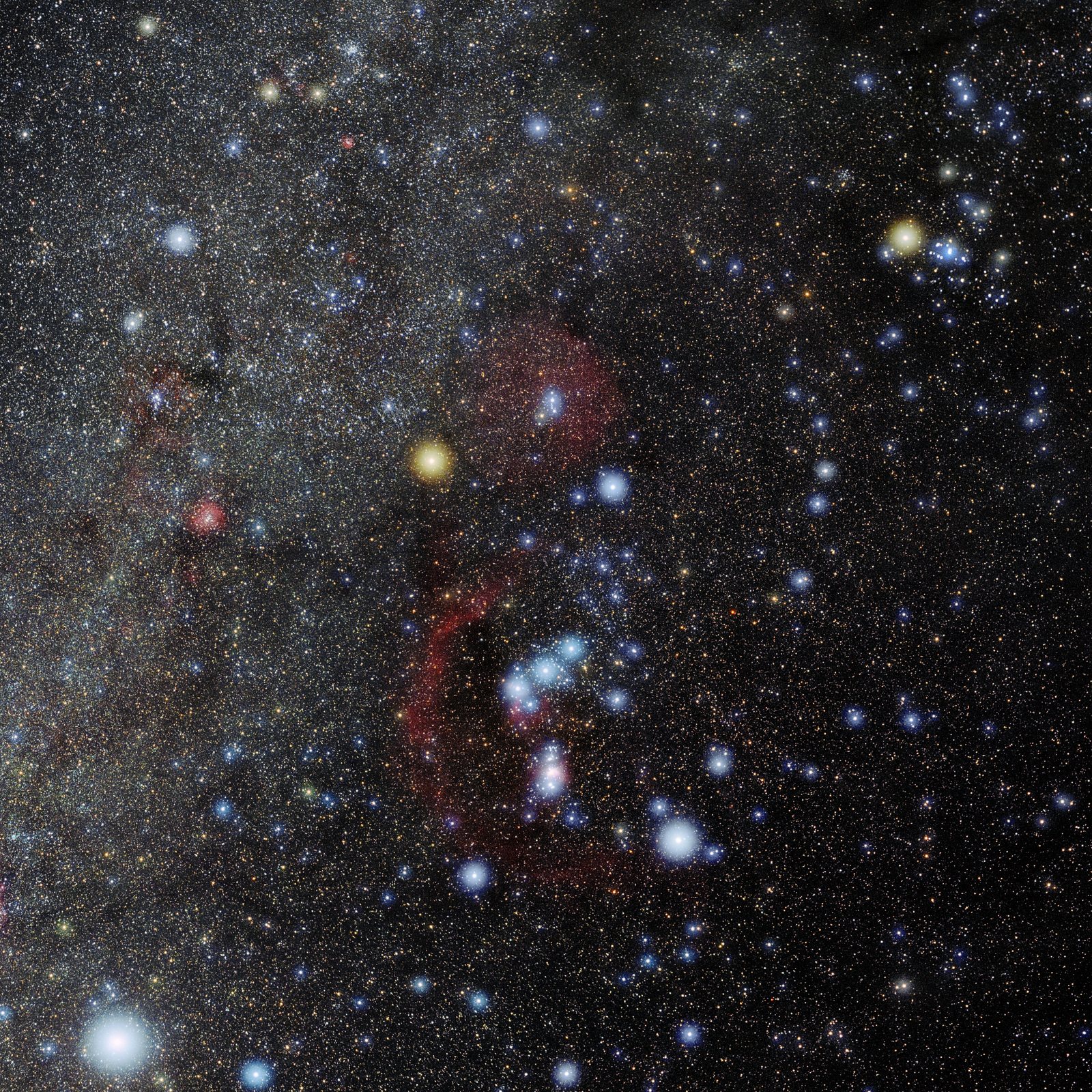
The Old Babylonian prayer to the gods of the night names Orion, and MUL.APIN calls it the True Shepherd of Anu. Orion's red shoulder star, Betelgeuse, is over 700 light-years away, according to ESO, and the Orion Nebula in the hunter's sword is about 1,500 light-years away. The tablets fix Orion by the day it first rose at dawn: MUL.APIN says the True Shepherd of Anu appears on the 10th day of Simanu, the third month. Precession slowly moves those dates through the year; the 2,700 years since the 687 BC copy are about a tenth of a cycle (our calculation from NASA's figure).
Orion, whole constellation, from ESO's La Silla Observatory in Chile. Zdeněk Bardon/ESO. CC BY 4.0SourceOrion, a second wide view. Its brightest red star is Betelgeuse. E. Slawik/NOIRLab/NSF/AURA/M. Zamani. CC BY 4.0SourceClose-up: Hubble's mosaic of the Orion Nebula, built from 520 images. NASA, ESA, M. Robberto (Space Telescope Science Institute/ESA) and the Hubble Space Telescope Orion Treasury Project Team. CC BY 4.0SourceClose-up, infrared: the Orion Bar, a ridge of gas and dust inside the Orion Nebula. ESA/Webb, NASA, CSA, M. Zamani (ESA/Webb), the PDRs4All ERS Team. CC BY 4.0Source
Every picture is shown with its credit and licence. Sources for the dates and distances: NASA, ESO, ESA/Hubble, ESA/Webb, ORACC and the papers linked in The 2.